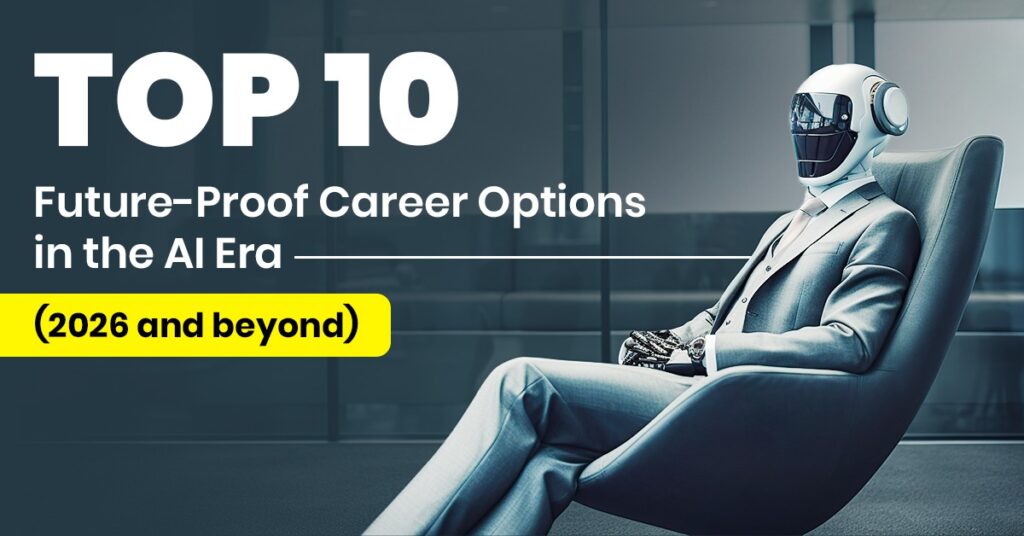
The future is safe for those who know how to use AI in their workflow. AI, GenAI, Agentic AI and other variants of AI are not our enemies, these are our partners, assistants, and highly helpful to improve our productivity and outcome.
Artificial Intelligence (AI) is no longer a future concept, it is already shaping how we work, learn, and build careers. From automation in offices to AI tools in healthcare, finance, and education, the job market is transforming rapidly. This has raised one big question among students and professionals alike;
Which careers will survive and grow in the AI era?
The answer lies in understanding where AI is strong and where humans remain irreplaceable.
Careers that are future-proof in 2026 and beyond generally fall into two major categories:
- Roles that build, manage, or govern AI
- Roles that depend on uniquely human skills like empathy, creativity, leadership, and complex physical work
According to the World Economic Forum, nearly 44% of workers’ skills will change by 2027, but roles that combine technology with human judgement (AI+HI) will see the strongest demand. Analytical thinking, leadership, and adaptability will be major skills in the future.
Let’s explore 10 future-proof career options, along with job roles, industries, companies, and why they are safe from AI disruption.
Source: Silicon Valley Girl
Category A: Roles in AI Development & Human–AI Interaction
According to tech billionaire Bill Gates, AI will make several jobs obsolete in coming years. However, three categories of jobs: Coders (architects of AI models), Energy Experts (Data centres and others), and biologists will survive this AI revolution, at least for now. (Source: Economic Times)
- AI/Machine Learning Engineer
AI Engineers are the architects behind intelligent systems like ChatGPT, Gemini, Perplexity, Claude, etc. They design, train, and optimise machine learning models that power chatbots, recommendation engines, fraud detection systems, and autonomous tools.
Why this role is future-proof.
AI cannot build itself. As adoption grows, organisations will need skilled professionals to customise models, improve accuracy, and ensure performance.
Typical Job Roles
- Machine Learning Engineer
- AI Research Engineer
- NLP Engineer
- Computer Vision Engineer
Key Industries
- IT & Software
- FinTech
- Healthcare Technology
- E-commerce
- Autonomous Vehicles
Top Hiring Companies
Google, Microsoft, OpenAI, Amazon, Infosys, TCS, Accenture
Skill Set Required
Python, R, TensorFlow, PyTorch, statistics, algorithms, problem-solving
- Cybersecurity Analyst & Ethical Hacker
As systems become smarter, cyber threats become more sophisticated. AI can detect patterns, but human intelligence is critical for anticipating new attack strategies and making judgement calls during breaches.
Why This Role is Future-Proof
AI strengthens cybercrime but it also increases the demand for human defenders who can think creatively and ethically.
Typical Job Roles
- Cybersecurity Analyst
- Ethical Hacker
- Penetration Tester
- Security Operations Centre (SOC) Analyst

Key Industries
- Banking & Finance
- Government & Defence
- Healthcare
- Cloud & SaaS Companies
Top Hiring Companies
IBM, Cisco, Deloitte, EY, Wipro, Palo Alto Networks
According to the 2025 ISC² Cybersecurity Workforce Study, 95% of organisations report at least one cybersecurity skills gap, with 59% facing critical or significant shortages.
The study highlights that skills shortages now pose a greater challenge than headcount alone, clearly indicating sustained and rising demand for qualified cybersecurity professionals worldwide in 2025 and beyond.
- Data Scientist and Data Strategist
AI can process data but it cannot decide what questions matter. Data Scientists translate raw data into meaningful business decisions.
Why This Role is Future-Proof
Organisations need humans to interpret insights, align data with strategy, and understand real-world impact.
Typical Job Roles
- Data Scientist
- Data Analyst
- Business Intelligence Analyst
- Data Strategy Consultant
Key Industries
- FMCG
- Healthcare
- Finance
- Retail
- EdTech
Top Hiring Companies
Amazon, Flipkart, Netflix, Reliance, PwC, KPMG
Skill Set Required
SQL, Python, statistics, data visualisation, business thinking
- AI Ethicist & Governance Specialist
AI systems can unintentionally promote bias, discrimination, or misuse data. AI Ethicists ensure technology is used responsibly and legally.
Why This Role is Future-proof
Ethics, law, and morality require human judgement, AI cannot regulate itself.
Typical Job Roles
- AI Ethics Consultant
- Responsible AI Officer
- AI Policy Analyst
- Tech Governance Specialist
Key Industries
- Big Tech
- Government Bodies
- Legal & Compliance Firms
- Healthcare & Finance
Who Hires
Technology companies, regulators, policy think tanks, multinational corporations
How Organisations are Adopting and Investing in Ethical AI.
- IBM has formal AI ethics principles focused on explainability, fairness, and transparency; provides the AI Fairness 360 toolkit.
- JPMorgan Chase maintains an ethics team within a 200-person AI research group; ranks highly for responsible AI transparency.
- Meta bases AI development on five responsibility pillars, including privacy & security and accountability & governance.
- National Institute of Standards and Technology (NIST)’s AI Risk Management Framework is used by companies to assess and manage AI risks.
- Amazon Web Services (AWS) offers a Responsible AI course via Machine Learning University and the SageMaker Clarify bias-detection tool.
- Accenture has trained an additional 40,000 employees in AI for its Generative AI Centre of Excellence.
- Dell Technologies publishes Principles for Ethical Artificial Intelligence to support transparency and trust.
- Ethical AI is increasingly embedded into Environmental, Social, and Governance (ESG) investment models, including human-impact evaluation of AI-intensive companies.
Source: World Knowledge Forum
- Human-AI Collaboration Designer / Product Manager
These professionals design systems where humans and AI work together, not against each other.
Why This Role is Future-Proof
This role sits at the intersection of technology, psychology, and user experience, something AI alone cannot manage.
Typical Job Roles
- AI Product Manager
- UX Designer (AI Systems)
- Human-Centred Design Lead
Key Industries
- SaaS
- Healthcare Tech
- Education Technology
- Enterprise Software
Top Hiring Companies
Adobe, Salesforce, SAP, Meta, startups building AI tools
Category B: Roles That Depend on Unique Human Skills
- Healthcare Professionals
AI can assist doctors but care, trust, empathy, and responsibility remain deeply human. According to the World Health Organisation projection there will be a global shortage of 10 to 18 million health professionals by 2030. Also, an additional 9 million nurses and midwives will be required by 2030.
Future-proof Roles
- Nurse Practitioners
- Therapists & Counsellors
- Surgeons
- Physiotherapists
Why Healthcare is Safe in the AI Era.
Patients do not just need diagnosis, they need reassurance, ethical judgement, and emotional support.

- Skilled People in Specific Trade
Hands-on jobs remain difficult to automate due to unpredictable physical environments. Platforms like Urban Company are making this highly unorganised sector into an organised employment sector.
People involved in this category are;
- Electrician
- Plumbers
- Carpenters
- Technicians (Computer, AC, etc.)
- Barber
- Beautician and more
Why these roles are safe
Robots struggle with real-world variability, on-site decision-making, and physical dexterity.
- Educators & Corporate Trainers
Education is not just about content, it’s about guidance, motivation, and emotional intelligence.
Future-proof roles
- School Teachers
- Online Tutors
- University Lecturers
- Corporate Trainers
- Learning & Development Specialists
Why educators matter
AI tools support learning, but humans shape thinking, values, and adaptability.
Emerging demand
Trainers who teach AI literacy, digital skills, and soft skills are especially in demand.

- Creative Professionals & Strategists
AI can generate content, but original thinking and cultural understanding remain human strengths.
Future-proof roles
- Creative Directors
- Brand Strategists
- UX Writers
- Film-makers & Designers
Why creativity survives

AI remixes the past; humans imagine the future.
Industries
Advertising, media, entertainment, digital marketing, product design
10) Business Leaders & Crisis Managers
Leadership requires accountability, trust, and emotional intelligence, qualities AI lacks.
Future-proof roles
- CEOs & Founders
- Strategy Consultants
- Operations Heads
- Crisis & Change Managers
Why leadership remains human
Handling conflict, uncertainty, and human emotions cannot be automated.
Skills That Make Any Career Future-Proof
Regardless of profession, these skills will matter most:
- Critical thinking
- Emotional intelligence
- Adaptability
- Communication
- Ethical judgement
- Lifelong learning mindset
Conclusion
The AI era is not about humans versus machines, it is about humans working smarter with machines. Careers that combine technology with empathy, creativity, judgement, and responsibility will continue to grow in value.
Instead of asking “Will AI take my job?”, the better question is;
“How can I make myself irreplaceable in an AI-driven world?”
Frequently Asked Questions
Are all jobs at risk because of AI?
No. Jobs that need human judgement, care, and creativity are safe.
Is it necessary to learn coding to survive in the AI era?
Not always. Soft skills and domain knowledge are equally important.
Which careers are safest till 2030?
Healthcare, cybersecurity, education, skilled trades, and leadership roles.
Can AI replace teachers completely?
No. Teachers guide emotions, thinking, and values, AI cannot do that.
What should students focus on in 2026?
Learn adaptable skills, understand AI basics, and build human strengths.


