
Winter has arrived, and with it the Delhi NCR pollution crisis is back in the headlines. To put in the context, as per today’s morning newspapers Delhi NCR recorded highest AQI 478 (Jahangirpuri) and minimum AQI 240 (Najafgarh) on 13th December 2025.
It puts us in the Severe Category and Government imposed GRAP IV along with hybrid classes for schools and 50% work from home for offices in Delhi. It is developing into a major health crisis with hospitals overloaded with patients with lung problems, asthma, and other pulmonary issues.
- In recent years asthma related hospitalisation has increased 20 to 25% during winters.
- Emergency hospital visits have increased significantly due to respiratory problems.
- Even breathing in this polluted air (high AQI) is equivalent to 20 to 50 cigarettes a day.
Source: Health and Me
Read Understanding Delhi NCR Pollution Crisis: Problem and Solutions for a detailed explanation of GRAP, AQI Levels, and Overall reasons and solutions.
Source: News9 Live
What are the Solutions to Keep Your Lungs Healthy in Delhi NCR Pollution Crisis?
- Use quality air purifiers (HEPA Filters) and humidifiers
- Vaccinations (Covid-19 and flu)
- Frequent hand wash can prevent viral spread
- Stay warm and cover up to restrict air hitting your lungs
- Always carry your inhaler and follow the treatment plan (for patients)
Why Indoor Air is Now as Dangerous as Outdoors.
The pollution in Delhi is not just about that brown smog you see outside. Ultra-fine PM2.5 particles seep indoors through doors, windows, exhaust fans and even tiny gaps in walls.
Doctors and public health experts repeatedly warn that prolonged exposure increases the risk of asthma attacks, COPD flare-ups, heart attacks, strokes and even cognitive decline.
Sensitive groups including children, seniors, and those with lung or heart disease are hit the hardest, even if they barely step outside. That’s why many doctors in Delhi now put indoor air quality at the same priority level as medicines and diet for high-risk patients.
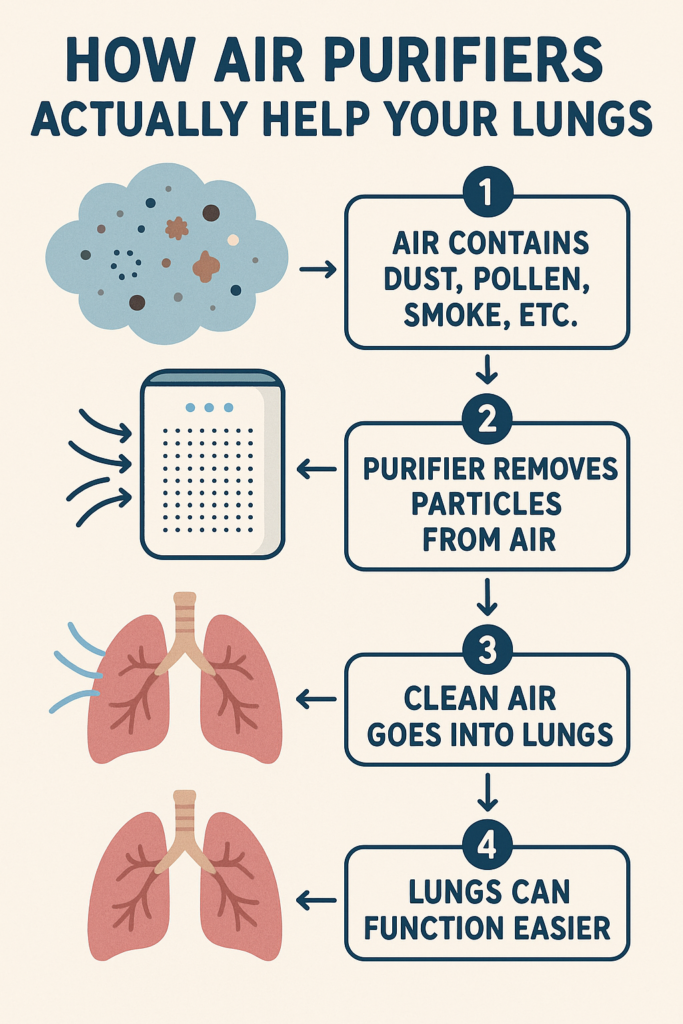
How Air Purifiers Actually Help Your Lungs.
How to Choose the Best Air Purifier: CADR, Room Size & Filters.
Before you jump into buying, keep this quick checklist:
- True HEPA filter (H13 or equivalent): Non-negotiable for asthma and allergies.
- CADR (Clean Air Delivery Rate) Higher CADR: faster cleaning. For Delhi, aim for 250–400 m³/h for medium rooms.
- Room coverage: Check sq. ft. rating; pick 1.5x your actual room size if pollution is extreme.
- Carbon filter: Helps with NO₂, SO₂, VOCs and foul smells from traffic and smoke.
- Filter cost and life: Check filter price on Amazon/Flipkart and typical life (6–12 months).
- Noise & power use: For bedrooms, low dB and ≤40W is ideal.
- No ioniser and ozone: Skip models that generate ozone; they can worsen asthma
Top 10 Air Purifiers To Protect Your Lungs in Delhi NCR Pollution Crisis
Now let’s break down the top 10 air purifiers in India that are especially relevant for dust, allergies and asthma in Delhi-NCR homes.
Dyson Purifier Cool Gen1 TP10
- Dyson’s Cool Gen1 TP10 is a tall tower purifier that combines powerful airflow with advanced sensing.
- It uses a HEPA H13 filter to capture ultra-fine particles along with a carbon layer for gases and odours.
- The bladeless fan design projects purified air across the room, and the machine monitors and displays air quality so you can actually see when the air gets better.
- Dyson’s purifiers are widely available in India via Amazon, Croma, Dyson’s own site and select offline stores, and they come with a two-year warranty on parts and labour.
- This is ideal for large living rooms or master bedrooms in premium homes in Delhi NCR pollution crisis.
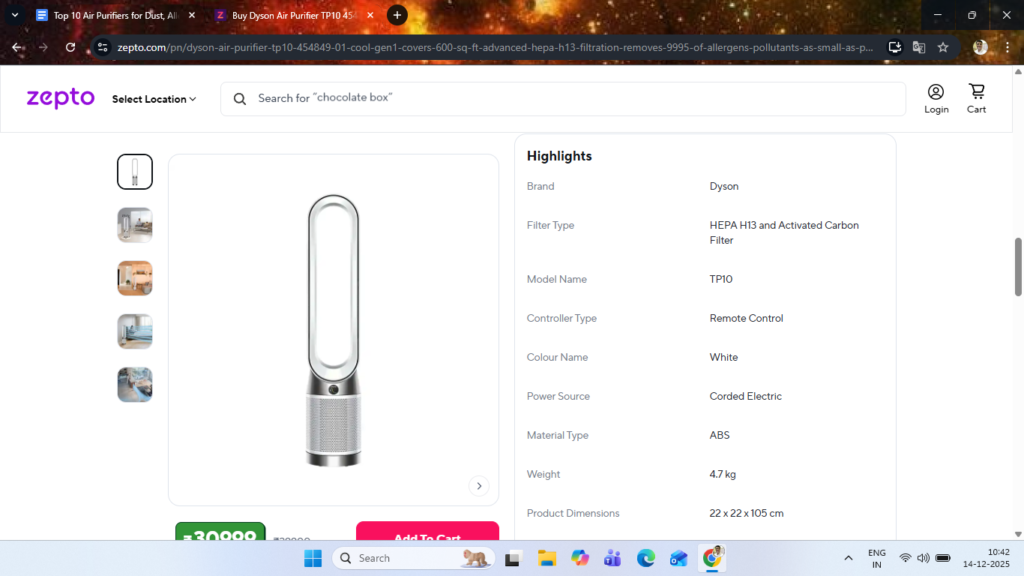
Source: Zepto
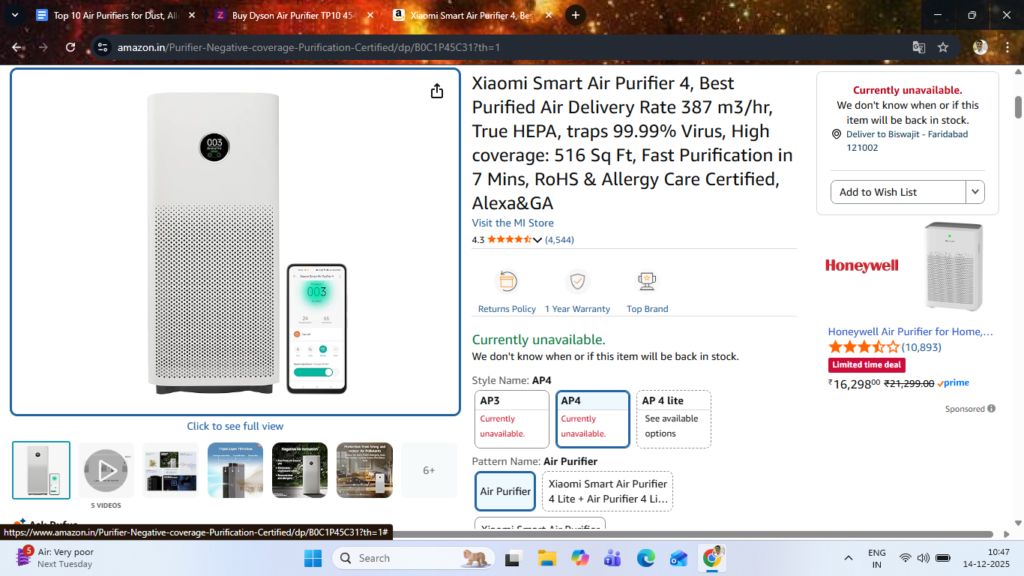
Xiaomi Smart Air Purifier 4
- The Xiaomi Smart Air Purifier 4 is one of the best combinations of performance and value for city apartments.
- A PM CADR of up to 387 m³/h and coverage of around 516 sq. ft. means it can quickly pull down PM2.5 spikes when a door opens or guests arrive.
- A True HEPA filter handles fine particles, while app control, voice assistant integration and real-time AQI readouts make it easy to operate.
- It’s regularly listed on Amazon, Flipkart and Reliance Digital, and is a strong pick if you need one machine to handle a typical Delhi drawing room.
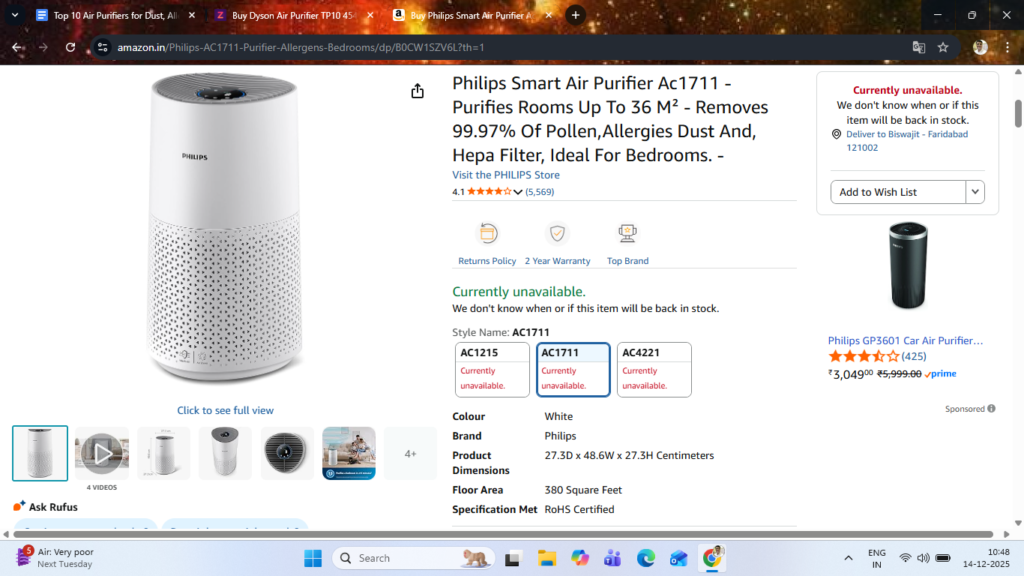
Philips AC1711/63: Quiet Bedroom Specialist
- The Philips AC1711/63 is a popular choice for bedrooms because it balances a CADR of around 300 m³/h with low noise and modest power consumption, roughly 27W in typical use.
- Philips uses a multi-layer filter stack rated to capture 99.97% of particles down to 0.003 microns in its latest 3000-series models, similar tech trickling into the AC1711 line.
- If you want something you can run all night for a child or elderly parent with asthma, this is a solid, hospital-grade feeling choice that’s easy to find on Amazon, Flipkart and Zepto.
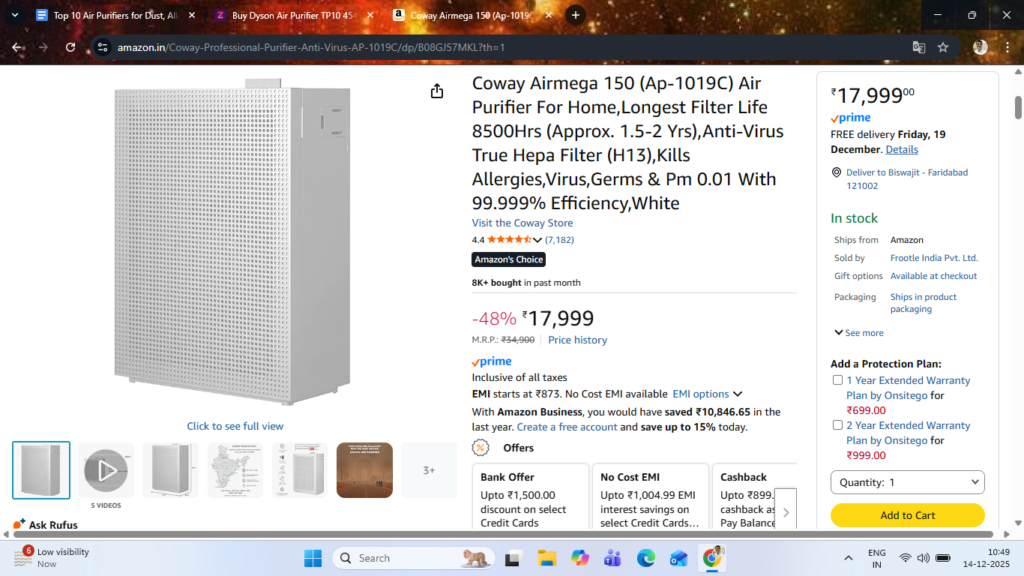
Coway AirMega 150 (AP-1019C)
- Coway has built a cult following in India for reliability and long filter life. The AirMega 150 (AP-1019C) is compact yet powerful enough for small to medium-sized rooms.
- It comes with a True HEPA filter and a pre-filter designed to trap Delhi’s heavy dust load before it clogs the HEPA.
- Independent testers and reviewers praise Coway for low noise levels and filters that can last up to 8,500 hours with proper maintenance.
- If you hate frequent filter changes and want a “buy and forget” workhorse, Coway deserves a serious look.
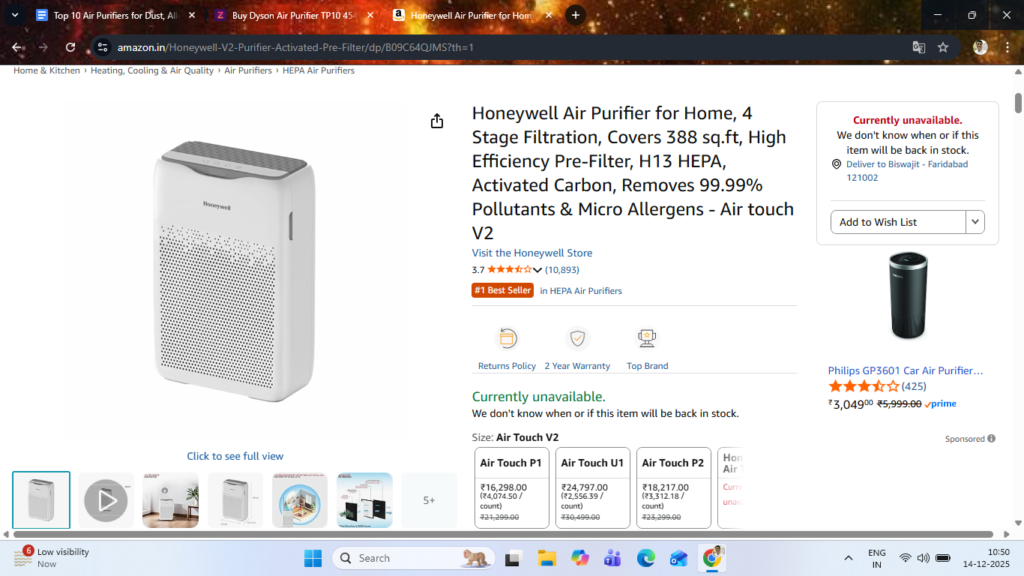
Honeywell Air Touch V2
- Honeywell has a long history in air filtration, and the Air Touch V2 brings that expertise into Indian homes.
- It generally offers a multi-stage filtration system with a high-efficiency HEPA filter plus an activated carbon layer, aimed at removing PM2.5, dust, pollen and VOCs.
- Its Clean Air Delivery Rate is suitable for typical bedrooms and small living rooms, and the design is kid-friendly with no sharp edges.
- This model often appears on Croma and Amazon with competitive pricing, making it appealing for families setting up their first serious purifier for asthma or allergy control.
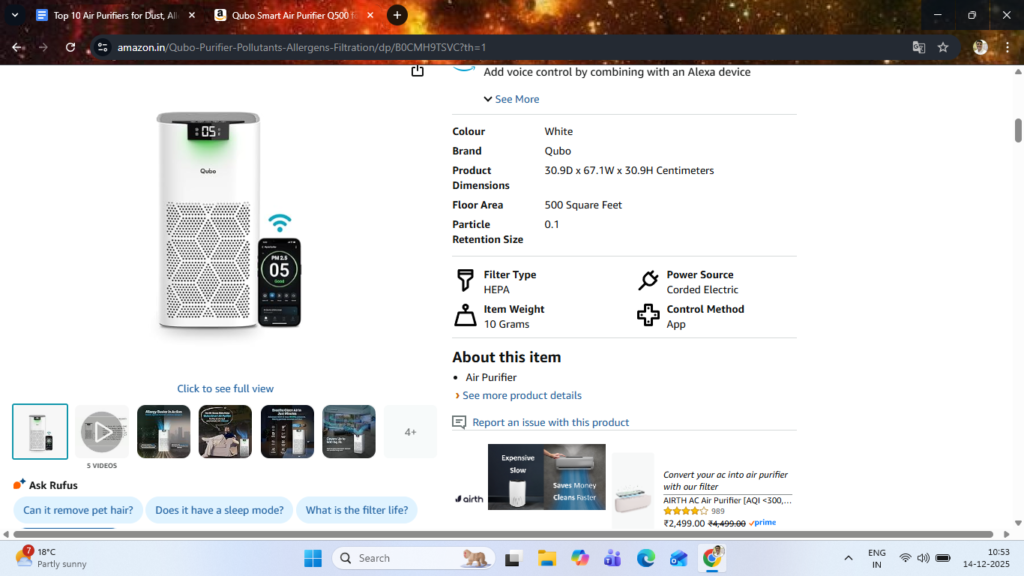
Qubo Q500 Smart Air Purifier
- Qubo (from Hero group) has emerged as an interesting “smart” local brand.
- The Qubo Q500 is frequently recommended for its good CADR relative to price and low annual filter cost (around Rs. 2,500 per replacement as per some reviews).
- It includes app control, AQI monitoring, scheduled operation and multiple modes (sleep, auto, turbo).
- For smaller flats in Noida or Gurugram where you want app-connected control and budget-friendly maintenance, this can be a very practical alternative to the bigger international brands.
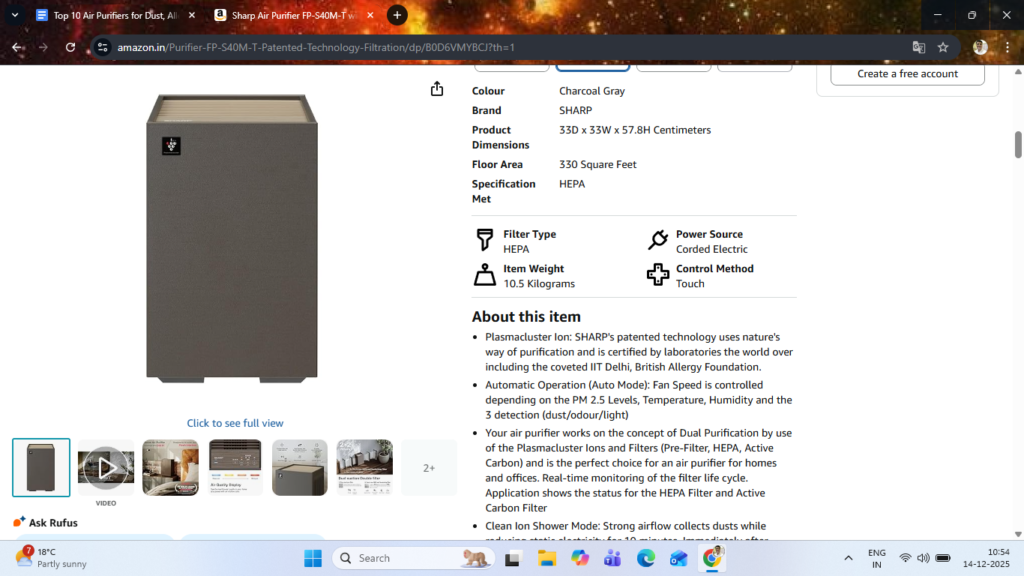
Sharp FP-S40M-T: Plasmacluster & HEPA Combo
- Sharp’s FP-S40M-T model pairs a True HEPA filter with their patented Plasmacluster ion technology that targets airborne microbes as well as dust and allergens.
- Sharp purifiers are often recommended for users with serious allergy or sinus issues because of this combination, and the FP-S40M-T is sized well for mid-sized bedrooms or studies.
- The unit is widely available on Amazon India and is known for quiet performance and solid build quality, making it a good “set it in the corner and forget it” appliance.
Philips 3200 Series AC3220/60
- If you have a larger drawing room or an open-plan living-dining area, look at Philips’ 3200-series models like AC3220/60.
- Philips claims it can clean rooms up to ~667 sq. ft. with a CADR of around 520 m³/h.
- It uses advanced HEPA and activated carbon filtration rated to remove 99.97% of particles as small as 0.003 microns.
- This is serious fire-power for days when AQI crosses 400 and you need to keep multiple family members safe in a shared space.
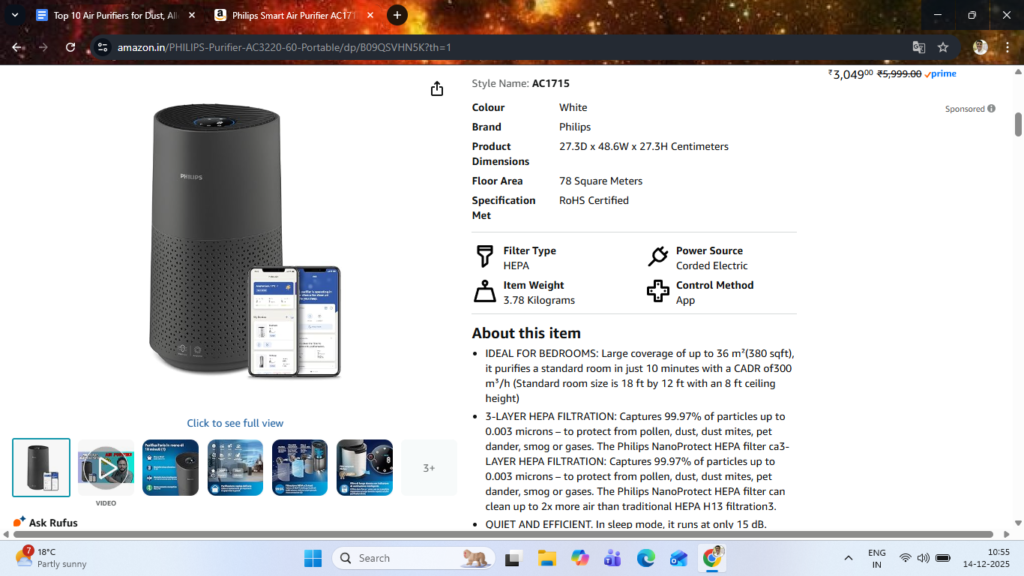
Eureka Forbes Air Purifier 270
- Eureka Forbes, known for water purifiers, also has a growing air range, and the 270 model is a good budget pick for renters and small families.
- With HEPA and carbon filtration, basic filter-change indicators and multi-speed modes, it focuses on essentials without driving up cost.
- It’s commonly available via Amazon, Flipkart and JioMart.
- If you want a secondary unit for a guest room, parents’ room or home office during peak smog months, this is a simple and wallet-friendly way to add another shield.
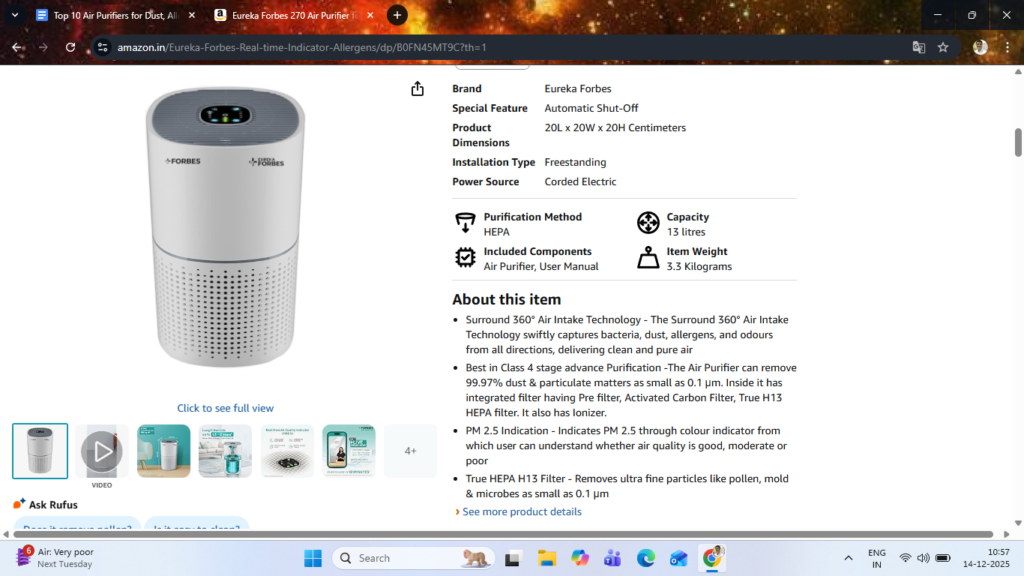
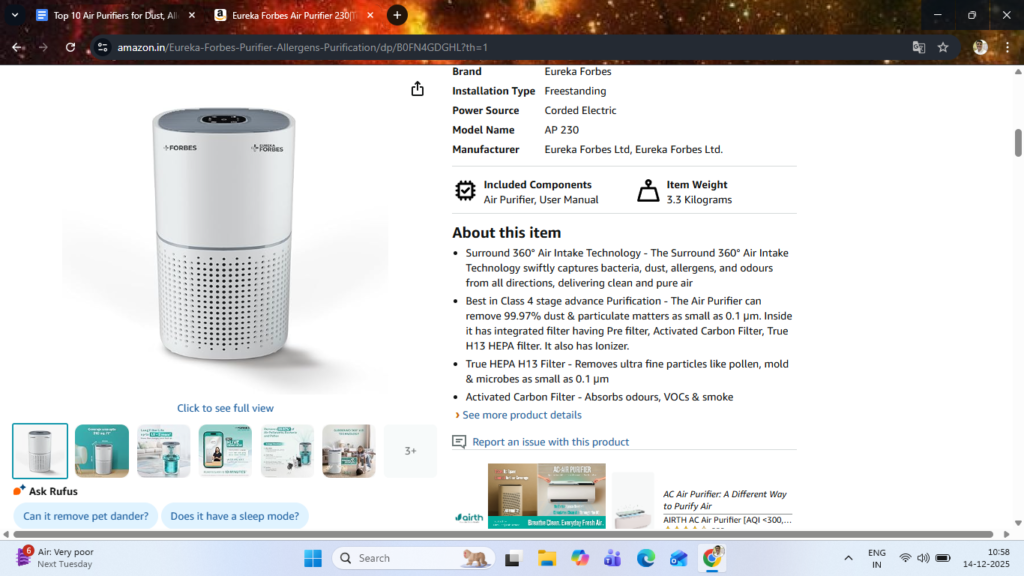
Eureka Forbes Air Purifier 230: Compact & Affordable
- The Air Purifier 230 is an even more compact option, often positioned for small rooms, PGs, hostels and compact bedrooms.
- It’s a step down in power versus the 270 but still offers multi-stage filtration suitable for confined spaces.
- This is a handy pick if you’re a student in Delhi-NCR or someone setting up a purifier in a small rented room and don’t want to invest in a premium model yet.
- Basic HEPA-grade filtration is still a huge upgrade over breathing unfiltered indoor air when AQI outside is in the 300–500+ range.
Conclusion: Putting It All Together for Your Home
With so many choices, people often ask which one is the best air purifier in India 2025. The honest answer is, it depends on your room size, budget, and health needs. For large living rooms, Dyson’s TP10, Xiaomi Smart Air Purifier 4 or Philips AC3220/60 are excellent.
For bedrooms, Philips AC1711/63, Coway AirMega 150 or Qubo Q500 strike a better balance of noise, price and performance. What truly matters is that you have at least one high-quality HEPA-based purifier running in the rooms where your family spends the most time, and that you change filters on schedule.
Source: The Grapevine
Frequently Asked Questions
Do I need a purifier in every room?
Ideally, yes but practically, start with the bedroom where you sleep 7 to 8 hours every night, then add one for the main living area. You can also move a single unit between rooms during the day and night if your layout allows.
Are air cleaners enough to protect me during severe smog days?
No single measure is enough. Combine indoor filtration with N95/N99 masks outdoors, keeping windows closed during peak hours, using exhaust fans wisely, and following your doctor’s advice if you have asthma or heart disease.
What’s the right CADR for my Delhi apartment?
A rough rule is CADR roughly equal to 2–3 times your room volume (in m³) per hour. For a 150 sq. ft. bedroom with a typical ceiling, aim for at least 220–250 m³/h; for a 250–300 sq. ft. hall, 300–400 m³/h or more is better, especially in NCR.
How often should I replace HEPA filters?
Most brands suggest every 6–12 months depending on usage and pollution level. In NCR’s winters, when devices run at higher speeds, filters may saturate faster. Always check the filter indicator and plan for yearly replacement cost while buying.
Are car purifiers or portable travel units worth it for Delhi visits?
If you commute long distances or frequently travel to Delhi for short trips, compact purifiers for hotel rooms and in-car devices can reduce exposure meaningfully, especially for sensitive individuals. They are not a replacement for full-size home units but a good add-on layer of protection.
If you’re in Delhi-NCR, think of these machines like seatbelts for your lungs. You hope you will never “need” them, but when AQI shoots past 300, you will be glad they are already on.


1 thought on “Top 10 Air Purifiers for Dust, Allergies & Asthma to Protect Your Lungs in Delhi NCR Pollution Crisis.”